The Unpublished Queue: How Kingston Chooses Which Crossings to Build
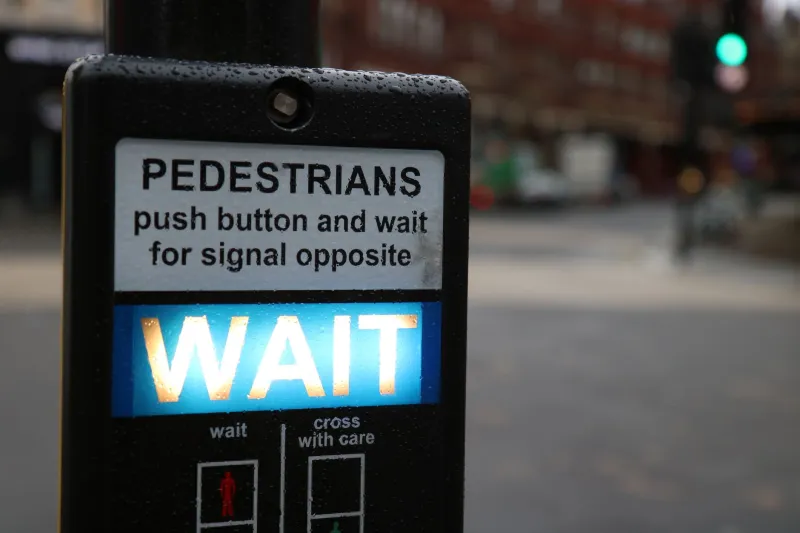
On a wet November morning, the case for a pedestrian crossing is usually made by a parent holding a child's hand at a kerb, a wheelchair user waiting for a gap in traffic, or an older resident timing a dash across a dual carriageway. In Kingston, those cases can be made formally: residents may ask the council for a zebra crossing, a signalised crossing or a school crossing patrol. What happens next is less visible. Requests are logged, assessed and sometimes funded, but the borough does not publish a single ranked waiting list showing which roads are next in line, which have been rejected, or how long residents might wait.
That absence matters in 2026. Kingston's highways team is juggling constrained Transport for London funding, developer contributions, routine resurfacing and a growing list of competing demands. In that environment, an unpublished queue is not a neutral administrative detail. It shapes which neighbourhoods get safer streets first.
A request, an assessment, a silence
The process begins in different ways. A resident may contact a ward councillor, submit a request through the council's website, start a petition or raise the issue at a local forum. Officers then consider whether the location meets the criteria for a formal crossing. In practice, that means looking at pedestrian and vehicle flows, recorded collision history, traffic speed, proximity to schools and shops, accessibility and the level of community support.
Not every request becomes a scheme. Some are redirected to smaller measures: a dropped kerb, a refuge island, tightened parking restrictions, a 20mph extension or a school street. Others are judged unsuitable because the road layout, sightlines or funding make a crossing impractical. The difficulty is that residents rarely see the reasoning in public. The council publishes general highways criteria, but not the running list of requests, the scores attached to them or the reasons for refusal.
A freedom of information request by Kingston Press asked for the current crossing request list. The council confirmed that requests are recorded and assessed, but indicated that there is no single public ranked waiting list of the kind used for some other council services. That may be technically accurate. The effect, however, is that the queue exists mainly inside officers' spreadsheets.
The scoring sheet residents cannot see
Kingston's assessment process is not arbitrary. Like most London boroughs, it uses a points-based framework to compare competing schemes. The usual ingredients are familiar: the number of pedestrians, the volume and speed of traffic, the collision record, the presence of schools, hospitals or sheltered housing, and the quality of the walking route.
The weighting is where discretion lives. A scheme with a strong collision record may score well, but collision data only captures reported incidents. Near misses, the everyday experience of parents and disabled residents, rarely appear in official statistics. A road that feels dangerous may not look dangerous on a spreadsheet.
Community support is another criterion that sounds neutral but can favour the well organised. A residents' association that can pack a public meeting, a school that can mobilise parents, or a ward councillor who knows how to frame a request may produce a stronger paper case than a quieter street with a worse record. That is not corruption. It is the ordinary advantage of people with time, confidence and knowledge of the system.
Where the casualties cluster
Published road safety data offers a partial map of risk. Across Kingston, pedestrian casualties are not evenly spread. Department for Transport STATS19 records, analysed at ward level, show clusters along the borough's main arterial roads: the A240 through Tolworth, the A243 towards Chessington, the A308 and Cambridge Road, and sections of Richmond Road. Wards such as Tolworth, Chessington South, Norbiton and Kingston Town have recorded higher pedestrian casualty counts in recent years than wards such as Coombe and Berrylands.
That pattern is not surprising. The busiest roads carry the most traffic and often have the weakest crossing points. But the data also exposes a gap between statistical risk and public pressure. A cluster of collisions near a shopping parade may generate fewer requests than a single near miss outside a popular primary school. Both are legitimate concerns. Only one tends to produce a petition.
The council's road safety dashboard records killed and seriously injured casualties, but it does not routinely publish the number of crossing requests received by ward, the average time from request to decision, or the proportion of requests that result in physical works. Without those figures, residents cannot tell whether the borough's crossing programme is following evidence or following noise.
The organised-ward advantage
There is no suggestion that Kingston officers ignore dangerous locations. The borough has delivered crossing improvements in recent years, and the 20mph programme has changed the character of many residential streets. But the absence of a public register makes it hard to test fairness.
Consider two requests. One comes from a school with an active parent group, a local councillor and a petition signed by hundreds. The other comes from a sheltered housing scheme where residents may not use the council's website and may not know that a request process exists. If both are assessed on the same criteria, the first is still more likely to be noticed. If the first is also better at supplying traffic counts or collecting evidence, the imbalance grows.
The risk is not that Kingston deliberately rewards the loudest. It is that a system without published queues and decision letters quietly rewards the best-connected. In a borough with sharp differences in income, language and civic confidence, that is a road safety issue as well as a democratic one.
Money, timing and the missing register
Crossings are expensive. A signalised crossing can cost hundreds of thousands of pounds once design, utility diversions and carriageway works are counted. Zebra crossings are cheaper but still compete with resurfacing, drainage and cycle schemes. Much of the funding comes through the Local Implementation Plan and developer contributions, both of which are tightly constrained.
That makes prioritisation inevitable. It does not make secrecy inevitable. A published crossing register could include the location, date of request, assessment score, current status and a brief reason for any rejection. It would not commit the council to building every scheme. It would simply allow residents to see the shape of the queue and to challenge the evidence if they believe it is wrong.
Kingston already publishes data on road collisions, parking penalties and some highways schemes. A crossing register would be a modest addition. The harder question is whether the borough wants to invite scrutiny of a process that currently operates with little external view.
A modest transparency test
The case for opening up Kingston's crossing queue is not that every request should be granted. It is that residents should be able to see how decisions are made before the tarmac is laid. Published criteria, ward-level request data and reasons for refusal would not solve the funding problem. They would, however, make it harder for the safest streets to be chosen simply because they are the best represented.
On a wet morning, the parent at the kerb does not care about scoring matrices. They care whether the traffic stops. But the route to that moment runs through a queue that Kingston keeps largely to itself. In 2026, with road safety ambitions still outstripping budgets, the least the borough can do is show residents where they stand in it.