The Cold Perimeter: Kingston’s Gritting Routes and the Streets Beyond the Line
On the first hard frost of the 2026 winter, Kingston’s streets divide into two categories: those the council treats and those it does not. The division is not random. It follows a published network of primary and secondary routes, drawn up around bus corridors, emergency access and steep gradients. But a map of priority is not the same as a map of need, and the gap between the two is where this investigation begins.
Kingston Press has compared the council’s published gritting routes with the locations of schools, care homes, GP surgeries, steep residential hills and estates at the borough’s edges. We have also asked what the winter service plan says about salt stocks, refill thresholds and the criteria used to add a road to the treated network. The picture is of a service that is professionally run but thinly stretched — and of communities who have learned to plan around it rather than rely on it.
The published line
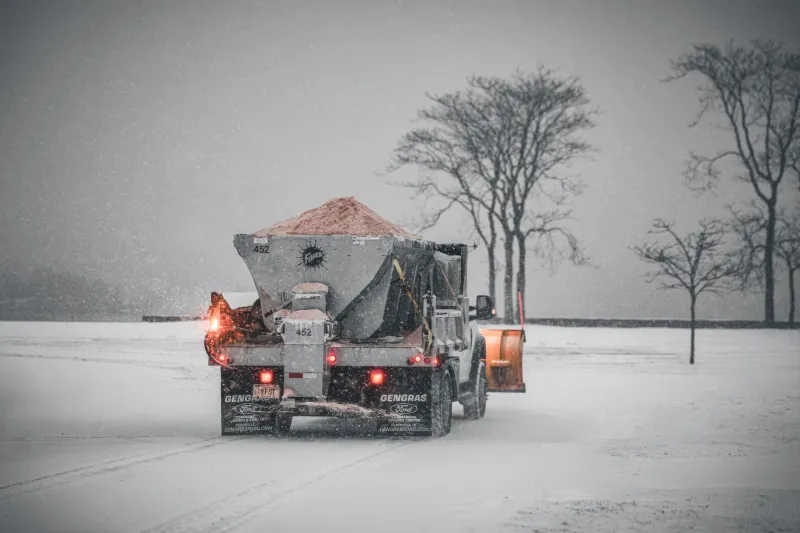
Kingston’s winter service treats a defined network of roads, typically classed as primary, secondary and access routes. Primary routes carry the most traffic and link key services; secondary routes support them. The council publishes a route list and maps, and its contractors deploy gritters when road surface temperatures are forecast to fall near or below freezing.
The logic is familiar across London boroughs: limited salt, limited vehicles, limited drivers, and a duty to keep the main arteries moving. A gritter that is sent up a quiet residential cul-de-sac is a gritter not sent along a bus route. That trade-off is real. The question is whether the line has been drawn in the right place, and whether it has been reviewed as the borough’s population and traffic patterns have changed.
What the criteria miss
The published network is built around movement, not access to services. That distinction matters outside a school gate on a January morning. Several primary schools in the borough sit on residential roads that are not treated, leaving parents and staff to navigate pavements and side streets that may not see a gritter at all. The same is true of some GP surgeries and pharmacies, particularly those set back from main roads in older residential areas.
Care homes present a sharper version of the problem. A care home on a treated road is accessible; one on an untreated side street may be reachable only by a vehicle that can handle the ice. Kingston’s winter plan acknowledges that the council will consider requests for additional treatment, but the process is not automatic and the criteria are not published in full.
Steep hills are another pressure point. Roads such as Kingston Hill and parts of Coombe are treated because they carry traffic and because ice on a gradient is dangerous. But smaller hills in outer wards — the kind that make a short walk to the shops treacherous for older residents — do not automatically qualify. Isolated estates, particularly those with a single access road, are similarly vulnerable. If that access road is not on the network, the estate can be cut off by a modest snowfall.
The salt arithmetic
Salt is the constraint that shapes everything else. The council holds a stock of treated salt at the start of the season and refills as it is used. The winter service plan sets out trigger conditions for gritting and describes how stock levels are monitored. But the plan does not guarantee a fixed number of treatments per road, and in a prolonged cold snap the service shifts to conserving salt for primary routes.
That is prudent practice, not a scandal. It is also the point at which residents notice the difference between a published route and a treated one. A road may be on the secondary network and still receive fewer treatments than a resident expects, because the gritter has been redirected to keep a bus corridor open. The council’s own communications urge residents to take care on untreated surfaces, but they do not always explain how the hierarchy is applied in practice.
The ward-by-ward question
Equity in gritting is not simply a matter of counting treated miles. Hilly wards need more salt than flat ones. Wards with a high proportion of older residents may need more attention to pavements and access roads. Wards at the borough’s edge may have longer routes and fewer alternative connections.
Our audit found that the published network is densest in the town centre and along the main radial roads, thinning out towards the borough’s boundaries. That is consistent with a traffic-led approach, but it means that some outer wards carry a larger share of untreated residential streets. Residents in these areas are more likely to rely on community salt bins, where they exist, or to buy their own salt.
The council does not publish a ward-level breakdown of gritting coverage, salt use or requests for additional treatment. Without that data, it is difficult to say whether the service is equitable or simply consistent. Consistency is not the same as fairness.
The self-help gap
Where the council stops, residents often start. Community salt bins, some funded by councils and some by residents’ associations, provide a first line of defence on pavements and side roads. But the provision is patchy. Some bins are filled by the council; others are the responsibility of local groups. Some have disappeared from the streetscape altogether.
Buying salt is not a trivial expense for every household, and it is not a reasonable expectation for every older or disabled resident. The result is a quiet privatisation of winter resilience: those who can afford salt, or who live in an organised street, cope better than those who cannot. That is a civic question, not just a maintenance one.
What the watchdog wants
Kingston Press is not arguing that every street should be gritted. That would be neither affordable nor practical. But the council should publish a fuller account of how the network is drawn, including the service-access criteria it uses when considering additions. It should release ward-level data on gritting coverage, salt use and requests for treatment. And it should maintain a public register of community salt bins, with clear information about who is responsible for filling them.
As the 2026 winter settles in, the cold perimeter of Kingston’s gritting map will be tested again. The streets beyond the line are not invisible to the people who live on them. They should not be invisible to the council either.